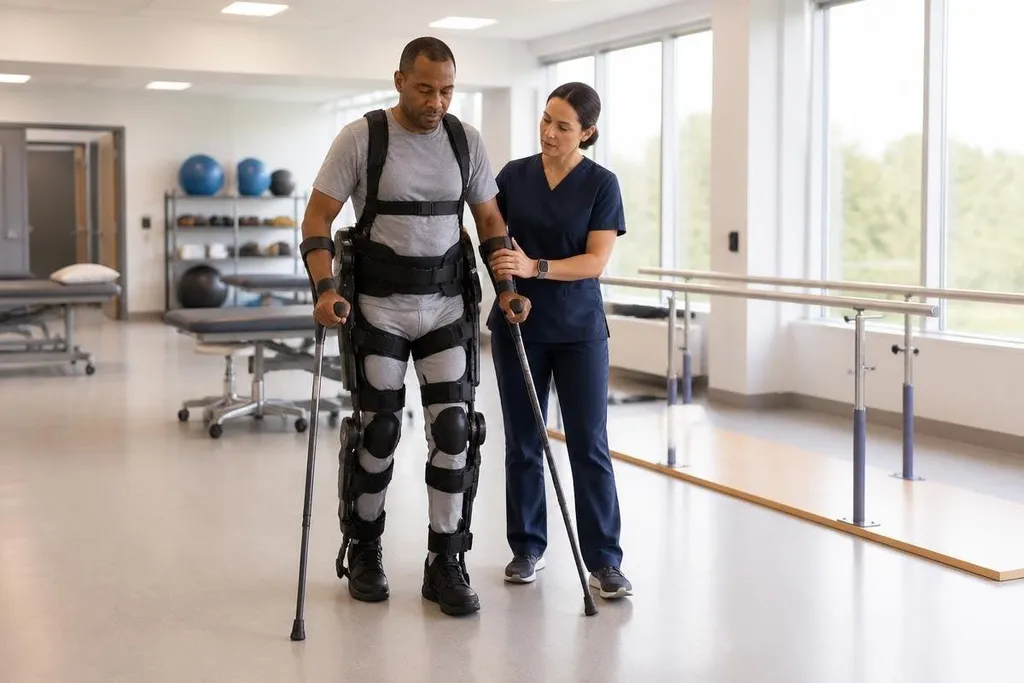
A powered leg exoskeleton can move a person’s hips and knees when their muscles cannot produce enough force. It may help someone practise standing and stepping, but it doesn’t restore walking by itself.
- Motors assist the leg joints during selected parts of a step.
- Sensors read movement, pressure, or joint position before the next action.
- Training time, balance, fit, and medical assessment decide who can use one safely.
How the hardware moves the legs
A medical exoskeleton uses a frame worn around the legs and sometimes the lower body. Motors sit near the hip or knee joints, where they can add movement without taking the person’s full weight.
The control system needs to know what the wearer is trying to do. Depending on the design, it may read foot pressure, joint position, buttons, or changes in the wearer’s posture. The software then selects an action such as standing, moving one leg, or stopping.
That timing matters. A knee motor that pushes too early can disturb balance. A motor that acts too late may fail to help the step. The frame also has to stay in place as the body moves, since a poor fit can create pressure on the skin or force the joints along the wrong path.
Battery size places a limit on the design. More motor power can help with heavier users, stairs, or weak muscles, but it also adds weight. A heavier frame can make transfers, storage, and training harder.
What walking practice can look like
A session may begin with standing, weight shifts, and short steps under supervision. The person may use parallel bars, crutches, or another support while they learn how the controls respond.
The exoskeleton can repeat a planned movement, but the wearer still needs to manage posture and balance. Some systems guide the legs through a set pattern. Others react to the wearer’s movement and add force only when needed. Those approaches place different demands on the person and the clinician.
The goal also changes from one person to another. One user may need help taking steps during therapy. Another may want to stand for a task or move across a room. Walking without the device is a separate result, and no frame can promise it for every user.
A walking exoskeleton needs more than a lab video to support a claim about daily use. Reports on walking exoskeletons from Robot24.com can name the frame, clinic, test date, and walking task. The next section looks at where these systems stop helping.
Where the limits appear
Balance is a major barrier. A leg frame can move the joints, but it may not correct every problem in the trunk, hips, or upper body. Many users still need crutches or another aid, especially while turning or moving over uneven ground.
Fit creates another constraint. A device built around fixed joint positions may work well for one body shape and cause pressure or poor movement for another. Clinicians also need to check skin condition, range of motion, bone health, pain, and fatigue before setting a session.
The open question is carryover. A person may take steps with powered assistance during therapy, yet that does not show they can walk without it. Progress needs repeated assessment outside the device, with the person’s safety kept ahead of step count.
I’d judge an exoskeleton by the useful movement it gives a specific person, not by a video of someone taking a few steps.
A practical check before use
Use these questions when a clinic or supplier discusses an exoskeleton:
- User fit: Can the frame match the person’s height, leg length, joint range, and body support needs?
- Task goal: Is the aim standing, therapy steps, indoor movement, or walking without the device?
- Human support: Who fits the frame, watches each session, and handles a fall or motor fault?
- Surface limits: Can it work only on a flat floor, or has the team checked ramps, turns, and thresholds?
- Training load: How long does setup take, and how much energy does the wearer spend during practice?
- Progress test: What measure will show change without the exoskeleton?
Those answers tell you more than a demonstration clip. Ask for the device’s weight, battery details, joint range, operating surfaces, and stopping method, then ask how the clinic will measure progress over time.
For now, exoskeletons make the most sense as supervised walking and standing tools for selected users. The useful test is still ahead: whether repeated assisted practice leads to safer, more independent movement when the motors are switched off.