

his article reflects my personal experience and ethical assessment as a former employee. All factual statements are based on publicly available sources cited below. I do not allege criminal wrongdoing by any individual or company.
There are moments in your career that really force you to pause, reassess where you are, what you’re involved in, and just how much you’re willing to accept.
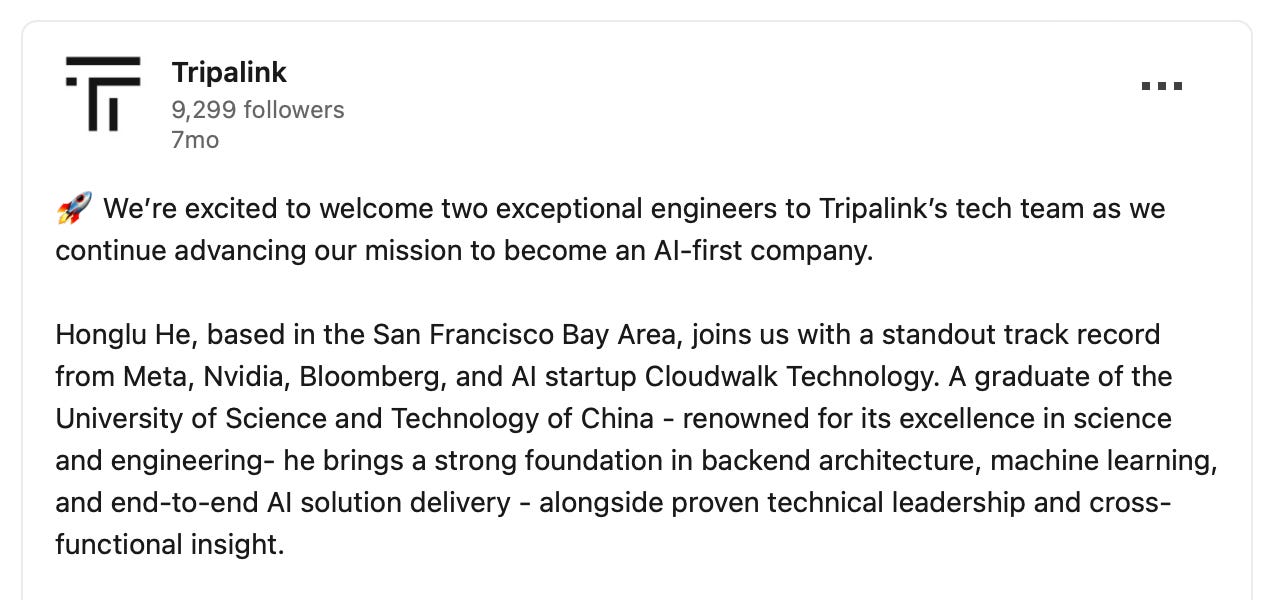
For me, that moment came while working at my previous employer, a Proptech company, after a leader joined the organization [11] (Figure 3). I do this sometimes — when someone new joins the company I’m at, I like to run a little background check, to find out who this is. After all, this new exec now had direct influence over my work and where the company was going. I certainly didn’t expect to find what I did.
An Unusual Timeline
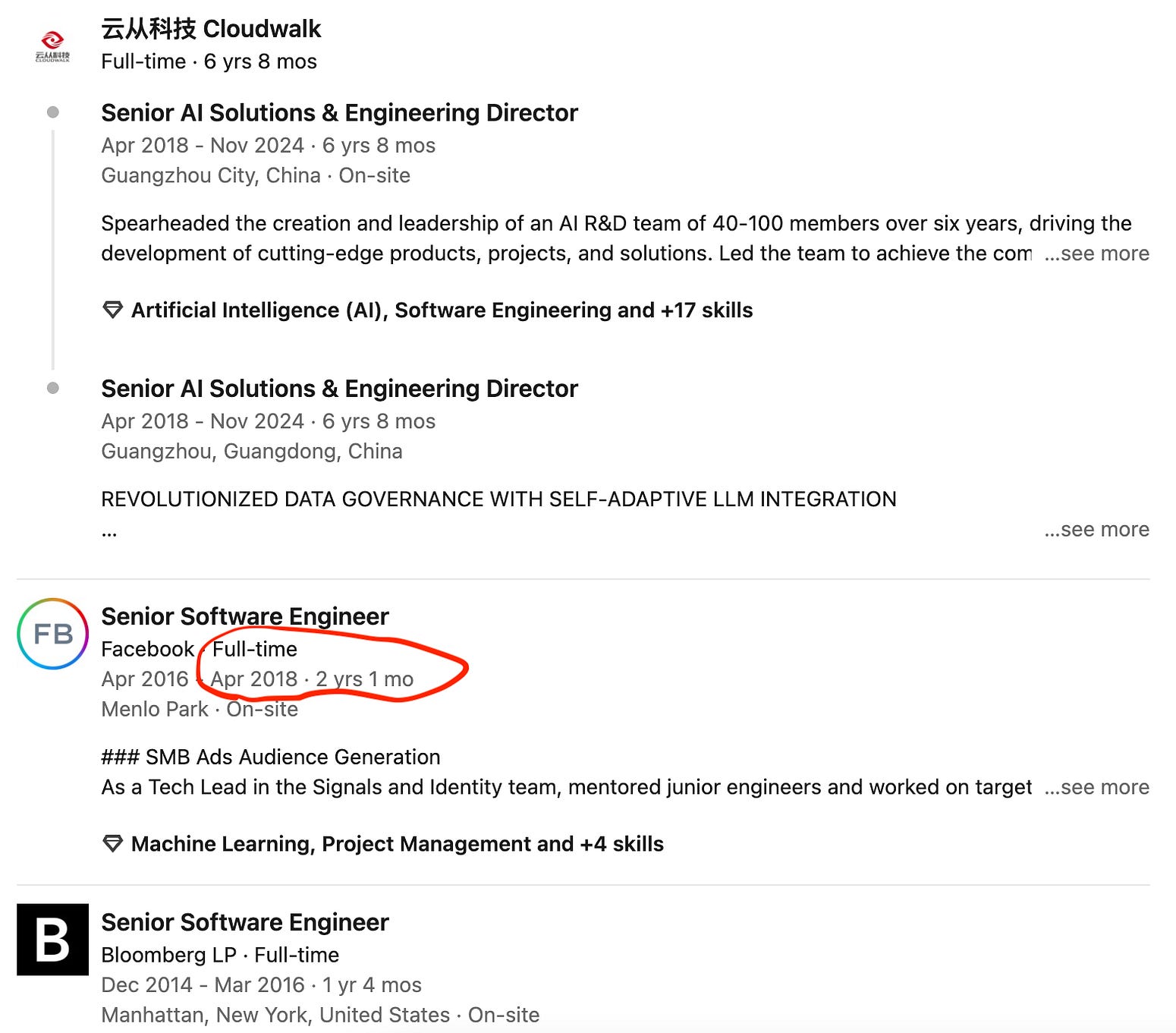
A quick LinkedIn search revealed this executive began working for CloudWalk (Yuncong) Technology, a Chinese artificial intelligence company, despite still being an official employee of Facebook, one of the most powerful technology companies in the US (and the world). This immediately raised concerns for me.
While he’d joined CloudWalk Technology, announced in News in December 2017 [1] (Figure 1), his employment at Facebook only ended in April 2018 (Figure 2), public records appear to show an overlap between the two roles of approximately five months [1].
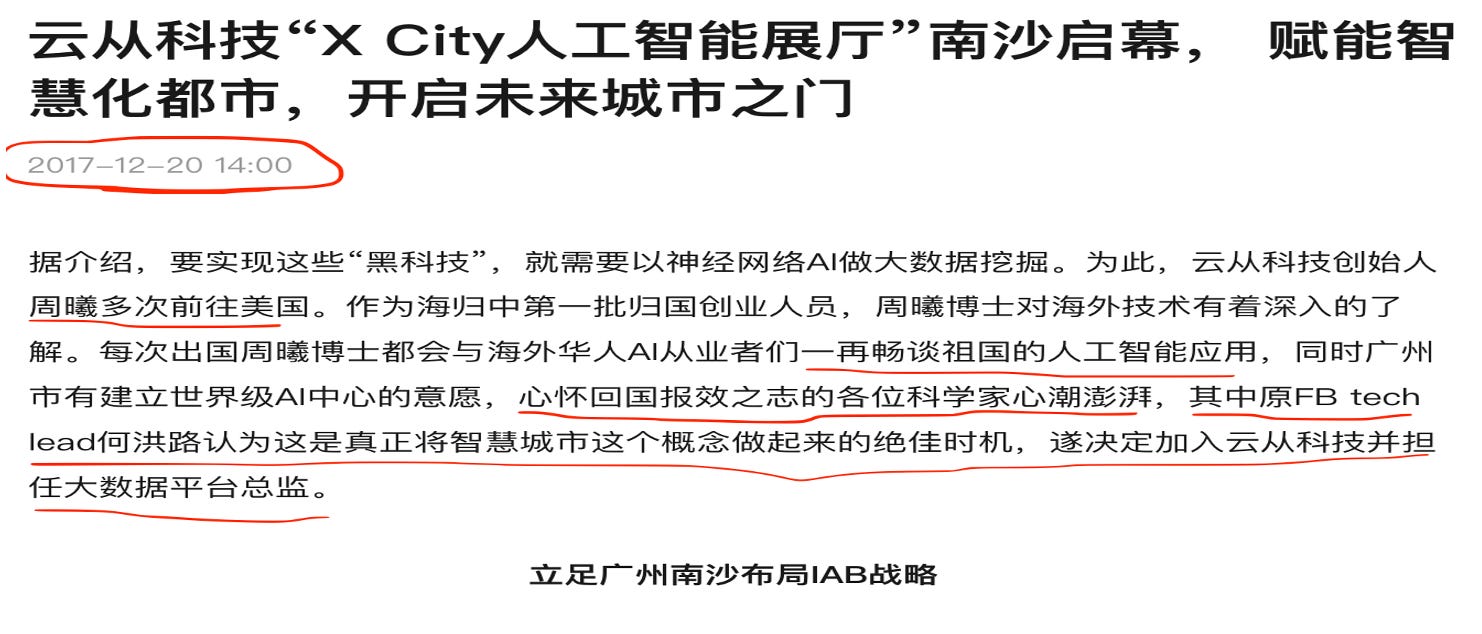
I found no public explanation for the overlap. No disclosure. No clarification of how conflicts of interest were handled. Could that be right? Had there been some oversight? And how could someone in a senior position blatantly overlook the direct ethical risk to both companies, their stakeholders, and general public trust?
Working simultaneously for a U.S. technology company and a fully state-linked Chinese AI firm overseas is a serious issue — especially at such a senior level. Had CloudWalk been experimenting on the margins, then perhaps it might’ve been more excusable. But CloudWalk, purely domestically funded enterprise, was a major player on the market that refused overseas investment, and relied solely on the Chinese funding [2]. This was all public information.
Publicly available information indicates CloudWalk’s line of work was widely documented at the time, and that the transition occurred while his U.S. employment was still ongoing.
In technology companies, overlapping senior employment isn’t just some technicality. These are people handling sensitive information every day. As such, to me, this represented an immense breach of trust.
Senior engineers and executives are entrusted with:
· Proprietary intellectual property;
· Strategic road-maps;
· Internal research and development;
· Institutional knowledge that competitors — and governments — value;
Most major tech firms explicitly prohibit outside employment or require full disclosure to protect their data, especially when another employer operates in the same arena or related domains.
Even if internal policies somehow allowed this kind of double-play, ethical responsibility should’ve prevented it.
The Broader Context That Made This Unacceptable
As a fellow professional in the tech industry, the overlap was hard to palate, to put it mildly.
At the time, I was working at an American start-up serving the U.S. public. Call me naive, but I took to heart the ethos that the company operated by. In theory, we are at the company valued ethical behavior and accountability. As an employee, I had hoped the leadership guiding our work observed those same standards, especially given the impact our technology could have on real people.
After a bit of digging, I found that CloudWalk later became the subject of U.S. government sanctions and was added to the Department of Commerce Entity List for its role in developing surveillance technologies linked to human rights abuses [3][4]. It was also subsequently designated by the Department of Defense as part of China’s military-industrial complex [5][6].
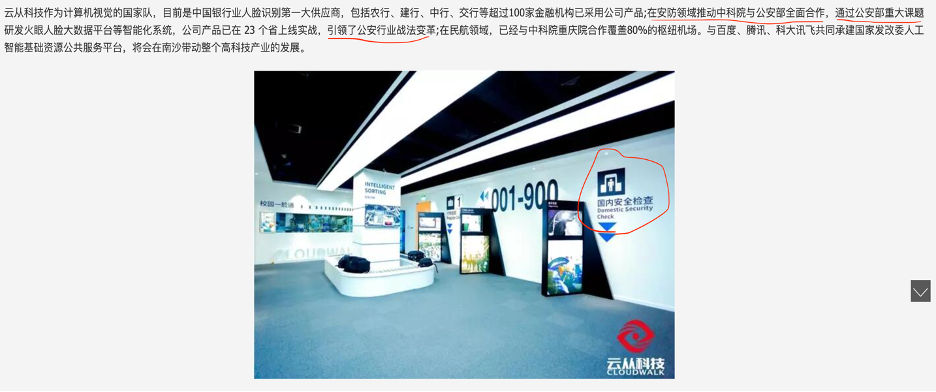
Additionally, public patent records [7][8][10] show Honglu He as an inventor on multiple Chinese patents related to facial recognition and surveillance systems filed during his tenure at CloudWalk. These patents relate to technologies that public sources have linked to China’s public-security and military apparatus [9] (Figure 4).
While these sanctions did not exist when the overlap period began, I don’t believe that erases ethical duty. More importantly, records (Figure 2) show he continued working on AI systems for CloudWalk for five more years after the company was sanctioned both by the U.S. Department of Commerce and Defense.
I couldn’t understand how somebody could spend over a decade working for reputable US tech companies, observing protocol, then just flip and do something like this. This deeply troubled me. From my perspective, the decisions reflected a lack of alignment with the ethical standards I expected from senior leadership. How could I go on to trust someone like this?
Ethics as a Guiding Light?
The discovery eventually sparked some much more unsettling realizations for me. What worried me more than the overlap itself was how easily such breaches of trust are concealed and made invisible, when it comes to leaders.
To me, ethical conduct’s about disclosing such (obvious) conflicts of interest and using one’s power responsibly.
Once somebody blurs the line so casually, there’s no telling what else they’re willing to compromise, or which truths might they bend to fit their narrative.
And if this was acceptable, then who’s to say further violations of trust, or graver misuse of technology wouldn’t be acceptable, also?
Power at the Top Doesn’t Get to Change the Rules
Someone in a junior position would obviously not have had the freedom to quietly overlap jobs or dabble in ethical gray areas. But seniors do. That discrepancy frustrated me.
This was a senior figure who’d decided to casually bend the rules, and redefine what was considered acceptable. Not only did that set a double-standard for the rest of the company, but it also set a dangerous precedent. If this could so easily be hidden from view, what else could be overlooked for the sake of professional fluidity? And how much could I, as a company employee, be comfortable with having hidden?
Though the company publicly celebrated this hire, it had in my view, failed to adequately consider ethical implications. As such, I was rapidly becoming aware I couldn’t in good conscience turn a blind eye, also.
Why I Ultimately Left and Why Stories Like This Matter
The decision to leave the company was not easy. Yet ultimately, after examining my conscience, I realized I did not want to work under a leadership that had:
· Simultaneously served a U.S. tech giant and a state-linked Chinese AI firm;
· Failed to demonstrate transparency around that overlap;
· Been involved in developing surveillance technologies later linked to the repression of minorities.
I could not reconcile that history with my own values. And frankly, I had a hard time accepting how my superiors had dismissed it as nothing out of the ordinary. I could no longer trust the people I worked for, nor could I have trusted myself, had I continued working there.
This isn’t an attempt to call out or condemn, but I don’t think such things should be overlooked in the corporate world. While senior leaders may have the ability to cross professional boundaries in such ways, it has a far more resounding impact across borders and ethical lines, affecting the entire company. It damages trust, public confidence in technology, and that’s not considering the communities potentially harmed by how that tech was used.
Ethics, to me, shouldn’t be about “playing it safe” only when others are watching, or when you can be held accountable by those higher-up. It’s the strength to walk away when your own lines of morality have been crossed, and not making excuses.
No statement herein is intended to assert violations of law. Readers are encouraged to review the cited sources and form their own conclusions.
References:
[1] https://www.sohu.com/a/211627399_643491
[2]
ChinAI #94: Cloudwalk — A “National Team” Member Unlike Any Other
Greetings from a land that is always in the process of becoming…
6 years ago · 2 likes · Jeffrey Ding
[3] https://home.treasury.gov/news/press-releases/jy0538
[4] https://technode.com/2020/05/25/us-adds-dozens-of-chinese-firms-to-trade-blacklist/
[5] https://media.defense.gov/2024/Jan/31/2003384819/-1/-1/0/1260H-LIST.PDF
[6] https://www.jdsupra.com/legalnews/dod-releases-new-list-of-section-889-1238296/
[7] https://patents.google.com/patent/CN113837034A/en
[8] https://patents.google.com/patent/CN112735015A/en
[9] https://m.ikanchai.com/pcarticle/184854